

For intended parents and their surrogate, IVF or In Vitro Fertilization is a crucial part of the surrogacy journey. IVF in the context of surrogacy is a process with several stages. Some happen in a laboratory. Others involve preparing the surrogate for transfer or monitoring an early pregnancy. Understanding how these stages connect can help everyone feel more prepared for what comes next.
Along the way,
- Intended parents face important decisions; from using their own eggs or sperm versus donor eggs or sperm to how many egg retrievals to attempt.
- For surrogates, it introduces appointments and medications that may feel unfamiliar, even after having children of their own. Bringing these experiences together takes communication, coordination, and support.
Imagine the moment intended parents hear that an embryo is ready for transfer. Their surrogate is preparing, too. She has experienced pregnancy before, but the IVF appointments and medications are new to her. For the intended parents, this may be their first experience with IVF or their first time going through it with a surrogate.
Their experiences are different but each step connects to the same plan. They share a question: what happens next?
This guide explains the medical steps of IVF in surrogacy, helping both understand what to expect before, during, and after embryo transfer.
How IVF Surrogacy Works, Medically Speaking
Let’s cover the basics about IVF first:
- IVF stands for in vitro fertilization (fertilization takes place outside of the body): eggs are retrieved from the ovaries and fertilized with sperm in a laboratory. The resulting embryos are monitored as they develop (embryo creation).
- An embryo may then be transferred into a uterus with the hope of establishing a pregnancy:
- It can be transferred back into the person who is the intended mother,
- or into the uterus of a surrogate (gestational carrier).

IVF gestational surrogacy process | More common IVF process |
| An embryo is transferred into the uterus of a surrogate who carries for the intended parents. | An embryo is transferred into the uterus of the person who plans to carry and parent the child. |
| Eggs come from an intended parent or donor, rather than the gestational carrier ⇒ surrogate is not genetically related to the baby. | Eggs may come from the person carrying the pregnancy or an egg donor. |
Here are medical procedures involved:
Embryo creation
Embryo creation is the prerequisite to every surrogacy journey. The IPs need to have successfully created embryos first before being able to transfer it to the surrogate’s womb. Embryo creation include:
Ovarian Stimulation
Ovarian stimulation is when fertility medication helps several eggs develop during one cycle. The goal is to collect as many eggs in one go as possible, to later on try and fertilize into embryos.
A typical menstrual cycle develops one dominant egg. IVF aims for multiple mature eggs in one cycle through daily fertility injections that stimulate several follicles; these are fluid-filled structures in the ovaries where eggs develop.
The intended parent patient or egg donor takes these medications for roughly a week and a half, though timing varies. The clinic monitors follicle growth and hormone levels through ultrasounds and blood tests, adjusting medication as needed.
Trigger Shot
The trigger shot is an injection that helps the eggs finish maturing before they are collected.
Once the follicles are ready, the clinic schedules a trigger shot the trigger shot for the intended parent or egg donor providing the eggs to help the eggs complete their final maturation before retrieval. The injection must be taken at the exact time instructed because egg retrieval is carefully scheduled around it.
Egg Retrieval
Egg retrieval is the procedure used to collect eggs from the ovaries.
About 36 hours after the trigger shot, the patient undergoes egg retrieval, usually an outpatient procedure under sedation. Using ultrasound guidance, the physician collects fluid from the ovarian follicles, and the embryology team identifies the eggs.
IVF involves a gradual decrease in numbers. For example, 15 follicles might yield 12 eggs, with 10 mature, 8 fertilized, and 5 reaching the blastocyst stage. Genetic testing, if performed, may further reduce the number considered suitable for transfer.
These numbers are only an illustration. The decrease in number, however, can be emotionally difficult, but it does NOT necessarily mean something went wrong. It is important to know that NOT every egg or embryo progresses through every stage.
Fertilization
Fertilization is when an egg and sperm join in the laboratory, beginning the development of an embryo.
The laboratory prepares fresh or previously frozen sperm from an intended father or donor and selects sperm for fertilization.
With conventional IVF, eggs and sperm are placed together in the laboratory. With ICSI (intracytoplasmic sperm injection), an embryologist injects a single sperm directly into an egg. The method depends on the clinic, the patient’s history, sperm quality, previous outcomes, and the treatment plan.
Embryo Development
Embryo development is the stage where fertilized eggs grow and are monitored in the laboratory.
Embryologists monitor fertilized eggs as they divide and develop, often aiming for the blastocyst stage around days five to seven. Not every embryo reaches this stage, which is part of the gradual decrease in numbers described earlier.
Embryos may receive grades, such as 5AA or 4BB, based on their appearance and development. Grading helps the clinic evaluate embryos but cannot guarantee whether one will result in pregnancy.
PGT & Genetic Testing
PGT & Genetic Testing is done to check a small sample of cells for certain genetic or chromosome conditions before the transfer.
Embryo Freezing, if applicable
Embryo Freezing is a process done to preserve the embryos so that they can be used for future transfers.
Once embryos reach the appropriate stage, those not being transferred immediately are usually frozen through vitrification, a rapid-freezing process, until the intended parents are ready.
In surrogacy, embryos may be created months or years before the intended parents meet their gestational carrier. With embryo creation complete, the next part of the shared journey focuses on preparing the surrogate to carry the pregnancy.
Embryo Transfer
Embryo transfer to gestational carrier is when the embryology team thaws the selected embryo, confirms it survived and is suitable for transfer, and places it into a thin catheter. A physician then places the embryo into the uterus.
Embryo transfer to gestational carrier is usually quicker and simpler than egg retrieval.
Once the surrogate is medically and legally cleared, the clinic creates her transfer calendar. Some cycles follow her natural hormones, while medicated cycles use hormones to prepare the uterine lining and coordinate timing.
This stage prepares the lining of the surrogate’s uterus to receive an embryo.
In a medicated cycle, estrogen helps build the uterine lining, called the endometrium. During a “lining check,” the clinic uses ultrasound and sometimes bloodwork to assess its thickness and appearance.
When the lining is ready, progesterone helps make it receptive to an embryo. The clinic carefully coordinates the duration of progesterone exposure with the embryo’s developmental stage. The surrogate should follow the exact medication schedule and contact the clinic about missed doses or before making changes.
Beta HCG
A beta hCG test, commonly called beta, is a blood test that checks for pregnancy after embryo transfer.
It is performed by the clinic, and measures hCG. If hCG is detected, testing is usually repeated to assess how levels change, since one result does not tell the whole story.
IVF Surrogacy Process in 10 Steps
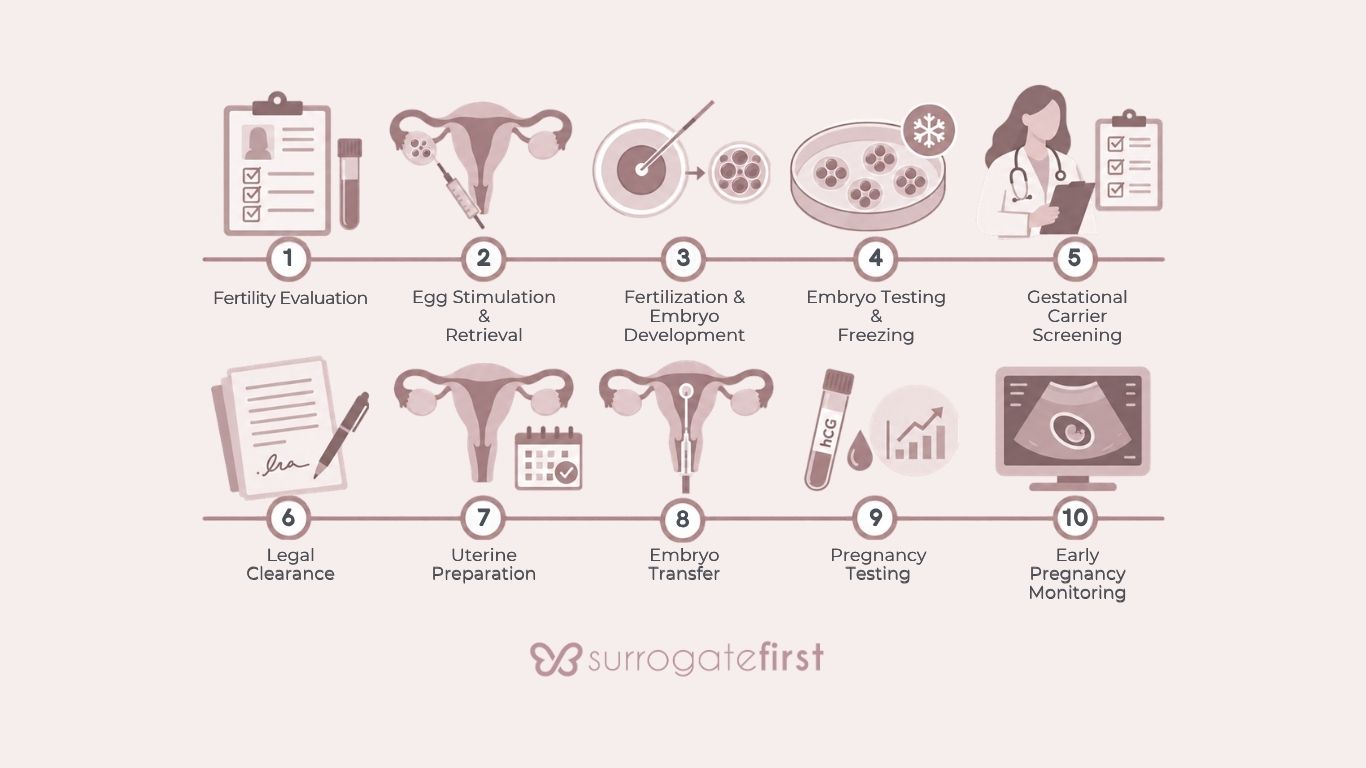
Step 1: Fertility evaluation
The intended parents and/or donors undergo testing so the fertility clinic can establish the IVF plan. This can include hormone testing, ultrasounds, semen analysis, medical history and infectious-disease screening.
Step 2: Egg stimulation & retrieval
The person providing the eggs takes fertility medication to develop multiple follicles. The clinic monitors their development through ultrasounds and blood tests. Once ready, a precisely timed trigger shot is given, followed roughly a day and a half later by the egg retrieval.
Step 3: Fertilization & embryo development
Sperm from an intended parent or donor is prepared, and the retrieved eggs are fertilized either through conventional IVF or ICSI. The resulting embryos are monitored for several days, usually aiming to reach the blastocyst stage around days 5–7.
Step 4: Embryo testing & freezing, if applicable
Step 5: Gestational carrier medical screening
Step 6: Legal Clearance
Before transfer medication begins, the intended parents and gestational carrier generally complete their surrogacy agreement with separate legal representation. Once the attorneys issue legal clearance, the fertility clinic can proceed.
Step 7: Prepare the gestational carrier uterus for transfer
The clinic creates a transfer calendar. Depending on the protocol, this can follow the surrogate’s natural cycle or use medication such as estrogen and progesterone. Ultrasounds and sometimes blood tests are used to check that the uterine lining is ready.
Step 8: Embryo transfer to gestational carrier
The selected embryo is thawed and checked by the embryology team. A physician then places it into the uterus using a thin catheter under ultrasound guidance. The surrogate usually continues her prescribed medications after transfer.
There is no need to hang upside down. Activity and rest should follow the treating clinic’s instructions, which may include taking it easy that day rather than strict bed rest.
Step 9: Pregnancy testing
After the transfer comes the waiting period. The clinic performs an HCG blood test, commonly called the beta, and normally repeats it to assess how the level is changing.
This wait can feel emotionally intense for the surrogate, intended parents, and support team, knowing how much time, money, effort, and hope brought them to this moment.
Step 10: Early Pregnancy Monitoring → Regular Prenatal Care
If the beta results progress appropriately, the clinic performs early ultrasounds and monitors milestones such as the gestational sac and heartbeat. Once the pregnancy is progressing normally, usually around 8–12 weeks, the surrogate transitions from the fertility clinic to her regular OB or maternity provider.
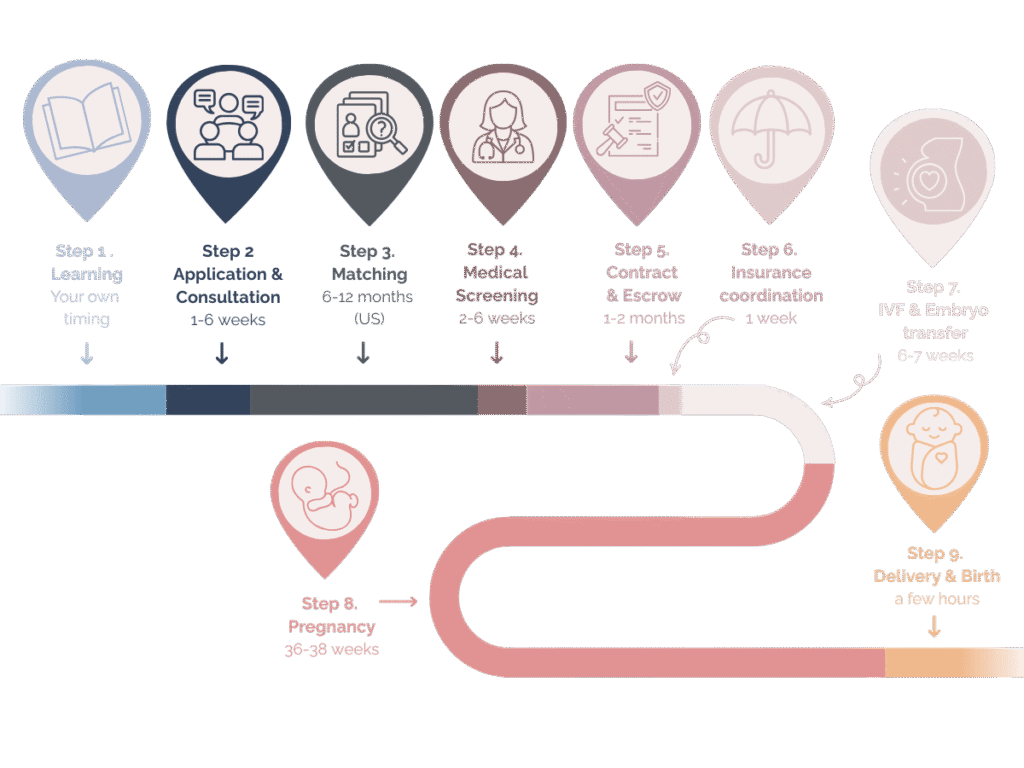
Surrogacy Process: full picture
IVF is one part of the wider surrogacy journey. From learning about surrogacy and finding a match to preparing for pregnancy and welcoming a baby, each stage brings its own preparation and support. The overview below shows where IVF fits into that journey. For a closer look at the full experience, explore our surrogacy process guide.
IVF Surrogacy Process FAQs
Who is involved in the IVF surrogacy process?
- Medical professionals such as embryologist, reproduction endocrinologist, fertility nurses
- Surrogacy professionals that help coordinate the journey, support communication, and connect participants with the appropriate professionals.
- Legal professionals that represent the intended parents and surrogate separately, explain their rights and responsibilities, and address the legal requirements.
What is IVF surrogacy?
IVF surrogacy is a family-building method that combines in vitro fertilization (IVF) with gestational surrogacy.
IVF surrogacy is for intended parents (intended single mothers, intended same-sex mothers) who cannot safely carry a pregnancy, same-sex male couples, intended single fathers
How Long Does the IVF Surrogacy Process Take?
Embryo creation and embryo transfer processes may happen months or even years apart (!)
- For intended parents: Initial testing and treatment planning come first. Once an egg-retrieval cycle begins, ovarian stimulation commonly takes about 8–14 days. Retrieval follows the trigger shot, and embryos develop in the laboratory over the following days. Testing, donor arrangements, additional retrievals, and matching with a surrogate can extend the overall timeline.
- For surrogates: Screening, legal clearance, and transfer preparation each take time. Once cleared, a surrogate follows the clinic’s transfer calendar. Preparation often takes several weeks, but the exact schedule depends on the protocol and how her body responds.
Who are the medical professionals involved in the IVF gestational surrogacy process
- Embryologist: Work in the laboratory to evaluate eggs, prepare for fertilization, monitor embryos, and freeze or thaw them.
- Reproductive Endocrinologist: A fertility physician who develops the treatment plan, oversees medical care, and performs or supervises procedures such as egg retrieval and embryo transfer.
- Fertility nurses: Explain medications, coordinate appointments, share results, and help patients follow their treatment calendars.
Is IVF more successful with a surrogate?
There is no universal answer. A gestational carrier can make pregnancy possible when an intended parent cannot carry or when pregnancy would be unsafe.
However, surrogacy does not guarantee implantation, pregnancy, or a live birth. Outcomes depend on several factors, including the age and quality of the eggs, sperm quality, embryo quality, the surrogate’s health, and the clinic’s treatment approach.
Your fertility team can explain whether a gestational carrier may improve your chances and provide estimates specific to your embryos and medical circumstances.
What are the typical stages of an IVF surrogacy journey?
The main stages are fertility evaluation, egg stimulation and retrieval, fertilization and embryo development, and optional embryo testing and freezing. The surrogate completes medical screening, legal clearance, and uterine preparation before embryo transfer. Pregnancy testing follows, then early pregnancy monitoring and a transition to regular prenatal care if the pregnancy progresses appropriately.
About SurrogateFirst
SurrogateFirst is a boutique surrogate agency specializing in quickly matching intended parents around the world with our fully-vetted, exceptional surrogates.
We help individuals and couples, regardless of race or sexual orientation, build their families through the miracle of surrogacy.
Every team member at SurrogateFirst is either a former intended parent or an experienced surrogate herself. We also have first-hand knowledge of what it takes to have an incredible, successful surrogate journey.