
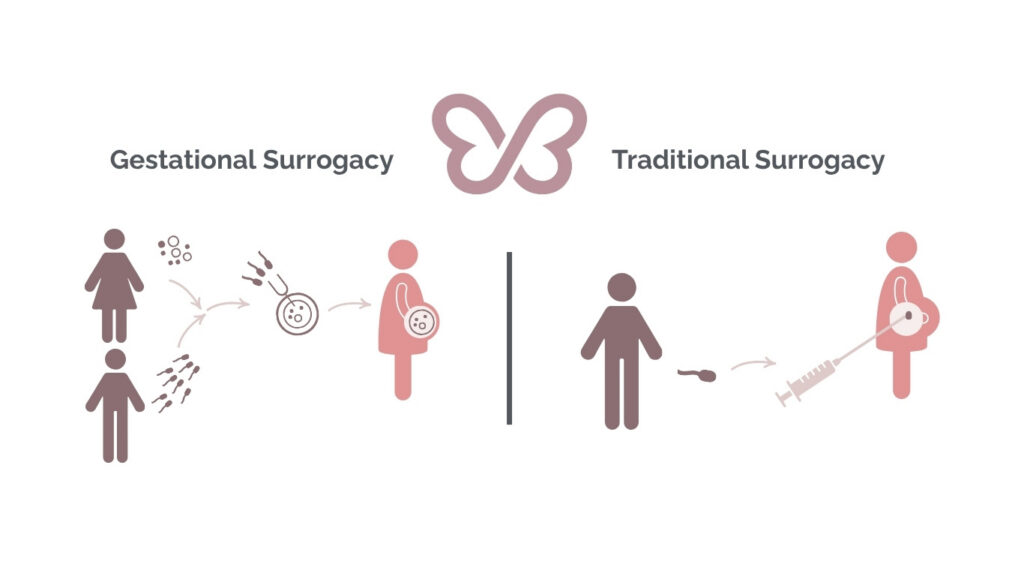
Both gestational and traditional surrogacy are different types of surrogacy.
Gestational vs traditional surrogacy: What is the difference?
The biggest difference between gestational and traditional surrogacy is whose egg is used to create the pregnancy.
In gestational surrogacy, the surrogate carries an embryo created using an egg from an intended parent or donor, so she has no genetic relationship to the baby.
In traditional surrogacy, the surrogate’s own egg is used, meaning she is both the person carrying the pregnancy and the child’s genetic mother.
That single difference affects much more than genetics. It changes the medical process, legal considerations, costs, and emotional experience of the journey. Today, gestational surrogacy is the more commonly practiced option in the United States, while traditional surrogacy has become increasingly uncommon.
| Gestational surrogacy | Traditional surrogacy | |
|---|---|---|
| Medical procedures involved | IVF | Intrauterine insemination (IUI) (most common) |
| Is the surrogate genetically linked to the baby? | No | Yes |
| Is this type of surrogacy legal? | Many states have clear legal frameworks and established processes in place. | Only a few states explicitly allow it or ban it. |
| What are the costs? | Detailed costs for surrogacy | IVF cost + depending on agreement |
Who is this type of surrogacy for? | Individuals with infertility, LGBTQ+ couples, single parents by choice, or anyone unable to safely carry a pregnancy | Not encouraged due to legal and emotional complexity |
| Does SurrogateFirst offer services? | Yes | No |
What is gestational surrogacy?
When you opt for gestational surrogacy, the surrogate acts more like a nurturing vessel to carry your child to term. She will not use her own egg; the embryo is created through in vitro fertilization using the egg from the intended parent or donor, and then transferred to the surrogate’s uterus.
This means that the child won’t have any of the surrogate’s genetic profile, which is the exact opposite of traditional surrogacy.
Gestational surrogacy entails a lengthy screening process to find out whether the surrogate is healthy enough physically, emotionally, and mentally to have a successful pregnancy.
- Over the past 30 years, gestational surrogacy has become more recognized as a way to start building a family.
What is traditional surrogacy?
Traditional surrogacy is the process where the surrogate uses her own egg, which means she is biologically and genetically related to the baby she carries. There are different ways this can happen, though nowadays it is most commonly done through a procedure called intrauterine insemination (IUI) which is a fertility treatment that involves placing sperm (the IP’s or a sperm donor’s) inside a woman’s uterus to facilitate fertilization.
- Traditional surrogacy was the only way to complete a surrogacy throughout most of history
- Though the last few decades developments now favor gestational surrogacy.
Pros and cons of gestational surrogacy
PROS
- No genetic relationship between the surrogate and the baby: The surrogate carries the pregnancy without the need to use her own egg, creating a clear distinction between her role and that of the child’s intended parents/genetic parents.
- A more established legal path: Many surrogacy-friendly states have established laws that specifically support gestational surrogacy agreements.
- More widely practiced and supported:Gestational surrogacy is the standard approach used by modern surrogacy agencies and fertility professionals today.
CONS
- Higher medical costs: IVF generally makes the medical part of gestational surrogacy more costly that an IUI based traditional journey.
- The journey can take more time – but not always: Gestational surrogacy follows a more established medical and legal processes that would require longer time even before the pregnancy begins though it would likely be faster to find a surrogate.
Pros and cons of Traditional surrogacy
PROS
- Lower initial medical costs: IUI is generally less expensive than IVF due to fewer medical procedures required.
- Familiarity as the foundation: When the surrogate is a friend or family member, the journey can begin with an already established relationship.
CONS
- More complex legal considerations: Establishing legal parentage for intended parents may require additional legal procedures because the surrogate is genetically related to the child.
- Greater emotional complexity: The surrogate being both the genetic mother and the person carrying the pregnancy can make roles, attachment and boundaries (especially during the transition) postpartum more difficult to navigate.
- Limited availability: This type of surrogacy is uncommon today so many agencies and fertility programs do not facilitate it.
Gestational vs traditional surrogacy: Which one is right for you?
- For most intended parents pursuing surrogacy in the United States today, gestational surrogacy is the more established and widely supported option.
- While traditional surrogacy may initially seem attractive because IUI can be simpler and less expensive than IVF, those advantages need to be weighed against the greater legal and emotional complexity created by the surrogate’s genetic relationship to the child. Traditional surrogacy is also restricted or handled differently in some jurisdictions and is no longer offered by many surrogacy programs.
If you decide to pursue gestational surrogacy, another decision is how you want your journey to be managed. Some intended parents pursue an independent journey, while others prefer the structure and professional guidance of an agency. Our Independent vs. Agency Surrogacy guide and Surrogacy Agency Guide can help you compare those options.
Location matters too. Laws, costs, eligibility requirements, and available types of surrogacy can vary significantly between countries. If you’re exploring options beyond the United States, see our International Surrogacy Comparison.
Ultimately, choosing a path isn’t simply about finding the easiest or least expensive option. It’s about creating a journey where the intended parents, surrogate, and future child are supported and protected from the very beginning.
Gestational vs traditional surrogacy FAQs
What are the main differences between gestational and traditional surrogacy?
The main difference is the surrogate’s genetic connection to the baby. In gestational surrogacy, an embryo created through IVF is transferred to the surrogate which makes her NOT genetically linked to the child whereas in traditional surrogacy, the surrogate’s own egg is used which makes her both the carrier of the pregnancy and the child’s genetic mother.
Legal implications of gestational versus traditional surrogacy in US states.
Surrogacy laws vary by state, but gestational surrogacy generally has a clearer and more established legal framework in surrogacy-friendly states. On the other hand, traditional surrogacy may face additional restrictions because the surrogate is genetically linked to the child which makes the intended parents’ legal parentage complicated.
How much does gestational surrogacy typically cost compared to traditional surrogacy?
Gestational surrogacy typically costs more than traditional surrogacy on average, mainly because of the medical process involved. Gestational surrogacy requires IVF to create and transfer an embryo, while traditional surrogacy may use IUI, which generally involves fewer fertility procedures and lower medical costs
What legal services are recommended for contracts in gestational vs traditional surrogacy?
Intended parents and surrogates should have separate attorneys experienced in reproductive and surrogacy law. This is applicable to both types.
Why SurrogateFirst?
At SurrogateFirst, we’re more than a matching agency—we’re your support system.
- Compassionate, personalized matching
- 24/7 access to dedicated case managers
- Legal and medical coordination
- Transparent pricing
- Emotional support for surrogates and for intended parents alike